
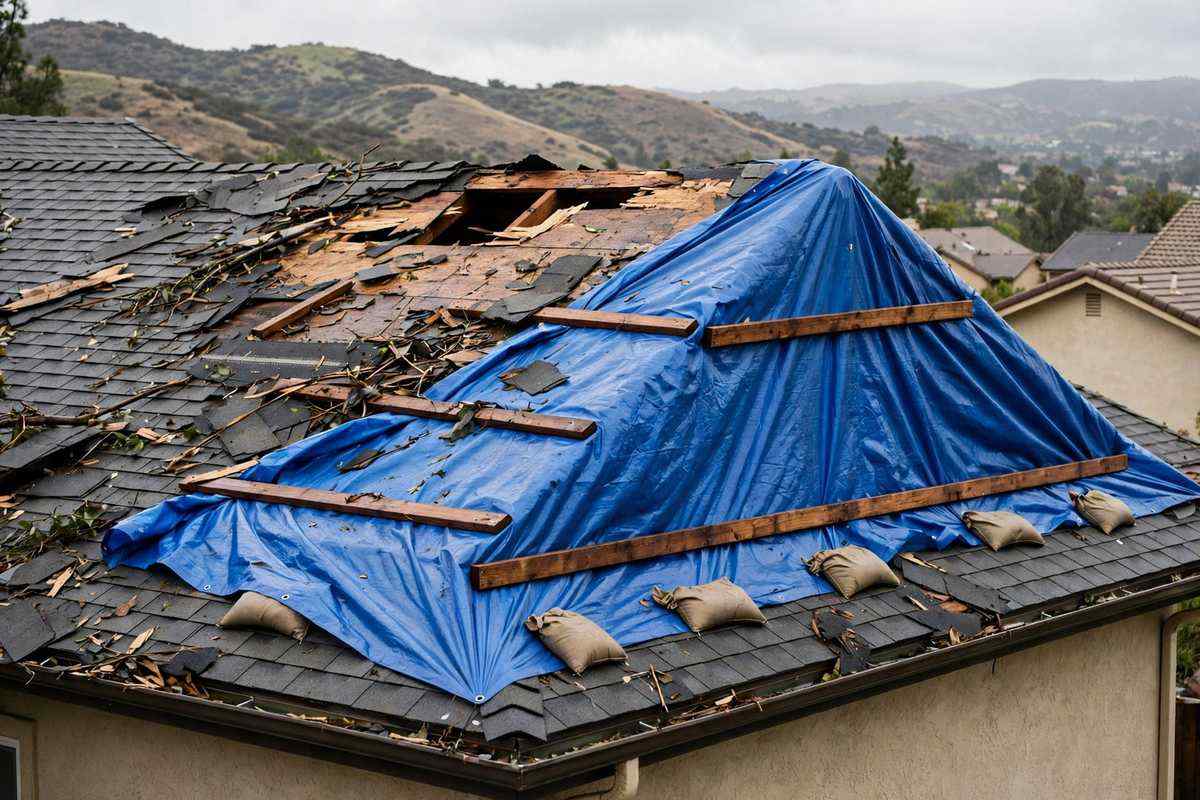
A roof that leaks after heavy rain in Simi Valley usually failed during the dry season, not during the storm. Sealants cracked in the heat, debris collected in valleys, and underlayment aged out under tile, all while the roof looked dry.
Why is my roof leaking after heavy rain in Simi Valley?
Winter rain is concentrated, so the first serious storm tests everything at once. Valleys, wall and chimney flashings, pipe boots and skylight curbs are the usual entry points, and water travels along the deck before it stains a ceiling.
Simi Valley is an incorporated city in Ventura County, incorporated on 10 October 1969, and permits inside city limits run through the City of Simi Valley Building & Safety Division, not through LADBS. The City's own FAQ states that re-roofing of more than 10 percent of the total square footage of the roof, or over 100 square feet, requires a permit. A job can therefore need a City permit without triggering other code thresholds, and the permit route, the fee line and the inspection outcome are confirmed at application, not assumed from another city's rules.
Why is my roof leaking after heavy rain in Simi Valley CA?
For a single-family re-roof in CEC Climate Zone 9, the Title 24 Part 6 prescriptive cool-roof values are an aged solar reflectance of at least 0.20 with thermal emittance of at least 0.75, or an SRI of at least 16, on steep slopes of 2:12 or more, and at least 0.63 with emittance of at least 0.75, or an SRI of at least 75, on low slopes under 2:12. That requirement is triggered when more than 50 percent of the roof area is replaced, which is a different threshold from the City permit trigger, and the parcel's zone should be checked with the CEC zone finder before a product is specified.
Simi Valley contains High and Very High Fire Hazard Severity Zone parcels, but it is not correct to say that all of Simi Valley is Very High. The parcel's zone must be checked in the CAL FIRE / VCFD Fire Hazard Severity Zone viewer, and on a wildland-urban interface parcel the current citation is Title 24 Part 7, the California Wildland-Urban Interface Code, not the retired CBC Chapter 7A. On such a parcel a Class A fire-rated roof assembly is required.
The most common roof leak causes in Simi Valley California
A roof that leaks after heavy rain in Simi Valley usually failed during the dry season, not during the storm. Sealants cracked in the heat, debris collected in valleys, and underlayment aged out under tile, all while the roof looked dry.
Flashing failures at walls, valleys, and chimneys
Winter rain is concentrated, so the first serious storm tests everything at once. Valleys, wall and chimney flashings, pipe boots and skylight curbs are the usual entry points, and water travels along the deck before it stains a ceiling.
Worn pipe boots and vent seals
A leak that returns after a repair was usually mis-traced, not under-repaired. The source, not the stain, is found first, and on a tile roof that source is often the underlayment, which means lift-and-relay on the affected slope, not another sealant coat.
Clogged or damaged gutters
Simi Valley is an incorporated city in Ventura County, incorporated on 10 October 1969, and permits inside city limits run through the City of Simi Valley Building & Safety Division, not through LADBS. The City's own FAQ states that re-roofing of more than 10 percent of the total square footage of the roof, or over 100 square feet, requires a permit. A job can therefore need a City permit without triggering other code thresholds, and the permit route, the fee line and the inspection outcome are confirmed at application, not assumed from another city's rules.
Shingle damage from wind and age
For a single-family re-roof in CEC Climate Zone 9, the Title 24 Part 6 prescriptive cool-roof values are an aged solar reflectance of at least 0.20 with thermal emittance of at least 0.75, or an SRI of at least 16, on steep slopes of 2:12 or more, and at least 0.63 with emittance of at least 0.75, or an SRI of at least 75, on low slopes under 2:12. That requirement is triggered when more than 50 percent of the roof area is replaced, which is a different threshold from the City permit trigger, and the parcel's zone should be checked with the CEC zone finder before a product is specified.
How to find a roof leak in Simi Valley CA
Simi Valley contains High and Very High Fire Hazard Severity Zone parcels, but it is not correct to say that all of Simi Valley is Very High. The parcel's zone must be checked in the CAL FIRE / VCFD Fire Hazard Severity Zone viewer, and on a wildland-urban interface parcel the current citation is Title 24 Part 7, the California Wildland-Urban Interface Code, not the retired CBC Chapter 7A. On such a parcel a Class A fire-rated roof assembly is required.
A roof that leaks after heavy rain in Simi Valley usually failed during the dry season, not during the storm. Sealants cracked in the heat, debris collected in valleys, and underlayment aged out under tile, all while the roof looked dry.
- Chimney and skylight flashing for lifted metal or cracked sealant
- Pipe boots for split rubber collars
- Valleys where two roof planes meet - look for missing granules or exposed nails
- Gutter joints and downspouts for overflow stains on the fascia
Winter rain is concentrated, so the first serious storm tests everything at once. Valleys, wall and chimney flashings, pipe boots and skylight curbs are the usual entry points, and water travels along the deck before it stains a ceiling.
What should I do if my roof leaks in Simi Valley California?
A leak that returns after a repair was usually mis-traced, not under-repaired. The source, not the stain, is found first, and on a tile roof that source is often the underlayment, which means lift-and-relay on the affected slope, not another sealant coat.
Simi Valley is an incorporated city in Ventura County, incorporated on 10 October 1969, and permits inside city limits run through the City of Simi Valley Building & Safety Division, not through LADBS. The City's own FAQ states that re-roofing of more than 10 percent of the total square footage of the roof, or over 100 square feet, requires a permit. A job can therefore need a City permit without triggering other code thresholds, and the permit route, the fee line and the inspection outcome are confirmed at application, not assumed from another city's rules.
For a single-family re-roof in CEC Climate Zone 9, the Title 24 Part 6 prescriptive cool-roof values are an aged solar reflectance of at least 0.20 with thermal emittance of at least 0.75, or an SRI of at least 16, on steep slopes of 2:12 or more, and at least 0.63 with emittance of at least 0.75, or an SRI of at least 75, on low slopes under 2:12. That requirement is triggered when more than 50 percent of the roof area is replaced, which is a different threshold from the City permit trigger, and the parcel's zone should be checked with the CEC zone finder before a product is specified.
Can heavy rain damage my roof in Simi Valley?
Simi Valley contains High and Very High Fire Hazard Severity Zone parcels, but it is not correct to say that all of Simi Valley is Very High. The parcel's zone must be checked in the CAL FIRE / VCFD Fire Hazard Severity Zone viewer, and on a wildland-urban interface parcel the current citation is Title 24 Part 7, the California Wildland-Urban Interface Code, not the retired CBC Chapter 7A. On such a parcel a Class A fire-rated roof assembly is required.
A roof that leaks after heavy rain in Simi Valley usually failed during the dry season, not during the storm. Sealants cracked in the heat, debris collected in valleys, and underlayment aged out under tile, all while the roof looked dry.
Winter rain is concentrated, so the first serious storm tests everything at once. Valleys, wall and chimney flashings, pipe boots and skylight curbs are the usual entry points, and water travels along the deck before it stains a ceiling.
Common mistakes to avoid when your roof is leaking
A leak that returns after a repair was usually mis-traced, not under-repaired. The source, not the stain, is found first, and on a tile roof that source is often the underlayment, which means lift-and-relay on the affected slope, not another sealant coat.
- Climbing on the roof in the rain. Wet shingles are slick, and a fall is far more expensive than any leak repair.
- Slapping sealant on the first wet spot you see. The leak source is often 10 feet away from the stain. Sealing the wrong spot wastes time and can trap moisture.
- Ignoring a small leak because it only drips in heavy rain. That drip is a warning. The next storm may be worse.
- Hiring the first person who answers the phone without checking their license. In California, roofing contractors must hold a valid CSLB license. Ask for the number and verify it.
Simi Valley is an incorporated city in Ventura County, incorporated on 10 October 1969, and permits inside city limits run through the City of Simi Valley Building & Safety Division, not through LADBS. The City's own FAQ states that re-roofing of more than 10 percent of the total square footage of the roof, or over 100 square feet, requires a permit. A job can therefore need a City permit without triggering other code thresholds, and the permit route, the fee line and the inspection outcome are confirmed at application, not assumed from another city's rules.
When to call a professional
For a single-family re-roof in CEC Climate Zone 9, the Title 24 Part 6 prescriptive cool-roof values are an aged solar reflectance of at least 0.20 with thermal emittance of at least 0.75, or an SRI of at least 16, on steep slopes of 2:12 or more, and at least 0.63 with emittance of at least 0.75, or an SRI of at least 75, on low slopes under 2:12. That requirement is triggered when more than 50 percent of the roof area is replaced, which is a different threshold from the City permit trigger, and the parcel's zone should be checked with the CEC zone finder before a product is specified.
Simi Valley contains High and Very High Fire Hazard Severity Zone parcels, but it is not correct to say that all of Simi Valley is Very High. The parcel's zone must be checked in the CAL FIRE / VCFD Fire Hazard Severity Zone viewer, and on a wildland-urban interface parcel the current citation is Title 24 Part 7, the California Wildland-Urban Interface Code, not the retired CBC Chapter 7A. On such a parcel a Class A fire-rated roof assembly is required.
Frequently Asked Questions
Why is my roof leaking after heavy rain in Simi Valley CA?
A roof that leaks after heavy rain in Simi Valley usually failed during the dry season, not during the storm. Sealants cracked in the heat, debris collected in valleys, and underlayment aged out under tile, all while the roof looked dry.
What should I do if my roof leaks in Simi Valley California?
Winter rain is concentrated, so the first serious storm tests everything at once. Valleys, wall and chimney flashings, pipe boots and skylight curbs are the usual entry points, and water travels along the deck before it stains a ceiling.
Can heavy rain damage my roof in Simi Valley?
A leak that returns after a repair was usually mis-traced, not under-repaired. The source, not the stain, is found first, and on a tile roof that source is often the underlayment, which means lift-and-relay on the affected slope, not another sealant coat.
How do I find a roof leak in Simi Valley CA?
Simi Valley is an incorporated city in Ventura County, incorporated on 10 October 1969, and permits inside city limits run through the City of Simi Valley Building & Safety Division, not through LADBS. The City's own FAQ states that re-roofing of more than 10 percent of the total square footage of the roof, or over 100 square feet, requires a permit. A job can therefore need a City permit without triggering other code thresholds, and the permit route, the fee line and the inspection outcome are confirmed at application, not assumed from another city's rules.
Does homeowners insurance cover roof leaks in Simi Valley?
For a single-family re-roof in CEC Climate Zone 9, the Title 24 Part 6 prescriptive cool-roof values are an aged solar reflectance of at least 0.20 with thermal emittance of at least 0.75, or an SRI of at least 16, on steep slopes of 2:12 or more, and at least 0.63 with emittance of at least 0.75, or an SRI of at least 75, on low slopes under 2:12. That requirement is triggered when more than 50 percent of the roof area is replaced, which is a different threshold from the City permit trigger, and the parcel's zone should be checked with the CEC zone finder before a product is specified.
Get help with Roofing in Simi Valley
Simi Valley contains High and Very High Fire Hazard Severity Zone parcels, but it is not correct to say that all of Simi Valley is Very High. The parcel's zone must be checked in the CAL FIRE / VCFD Fire Hazard Severity Zone viewer, and on a wildland-urban interface parcel the current citation is Title 24 Part 7, the California Wildland-Urban Interface Code, not the retired CBC Chapter 7A. On such a parcel a Class A fire-rated roof assembly is required.