
Summer heat in Simi Valley punishes a roof through ultraviolet exposure and thermal cycling, and preparation means ventilation, underlayment and covering chosen together, not a single product.
How to prepare your roof for Simi Valley summer heat
Before summer, check ridge and soffit ventilation as a system, clear valleys and gutters of debris that traps heat and moisture, and replace dried pipe boots and cracked sealants that the heat has already opened.
Simi Valley is an incorporated city in Ventura County, incorporated on 10 October 1969, and permits inside city limits run through the City of Simi Valley Building & Safety Division, not through LADBS. The City's own FAQ states that re-roofing of more than 10 percent of the total square footage of the roof, or over 100 square feet, requires a permit. A job can therefore need a City permit without triggering other code thresholds, and the permit route, the fee line and the inspection outcome are confirmed at application, not assumed from another city's rules.
For a single-family re-roof in CEC Climate Zone 9, the Title 24 Part 6 prescriptive cool-roof values are an aged solar reflectance of at least 0.20 with thermal emittance of at least 0.75, or an SRI of at least 16, on steep slopes of 2:12 or more, and at least 0.63 with emittance of at least 0.75, or an SRI of at least 75, on low slopes under 2:12. That requirement is triggered when more than 50 percent of the roof area is replaced, which is a different threshold from the City permit trigger, and the parcel's zone should be checked with the CEC zone finder before a product is specified.
Why Simi Valley summers punish roofs
Simi Valley contains High and Very High Fire Hazard Severity Zone parcels, but it is not correct to say that all of Simi Valley is Very High. The parcel's zone must be checked in the CAL FIRE / VCFD Fire Hazard Severity Zone viewer, and on a wildland-urban interface parcel the current citation is Title 24 Part 7, the California Wildland-Urban Interface Code, not the retired CBC Chapter 7A. On such a parcel a Class A fire-rated roof assembly is required.
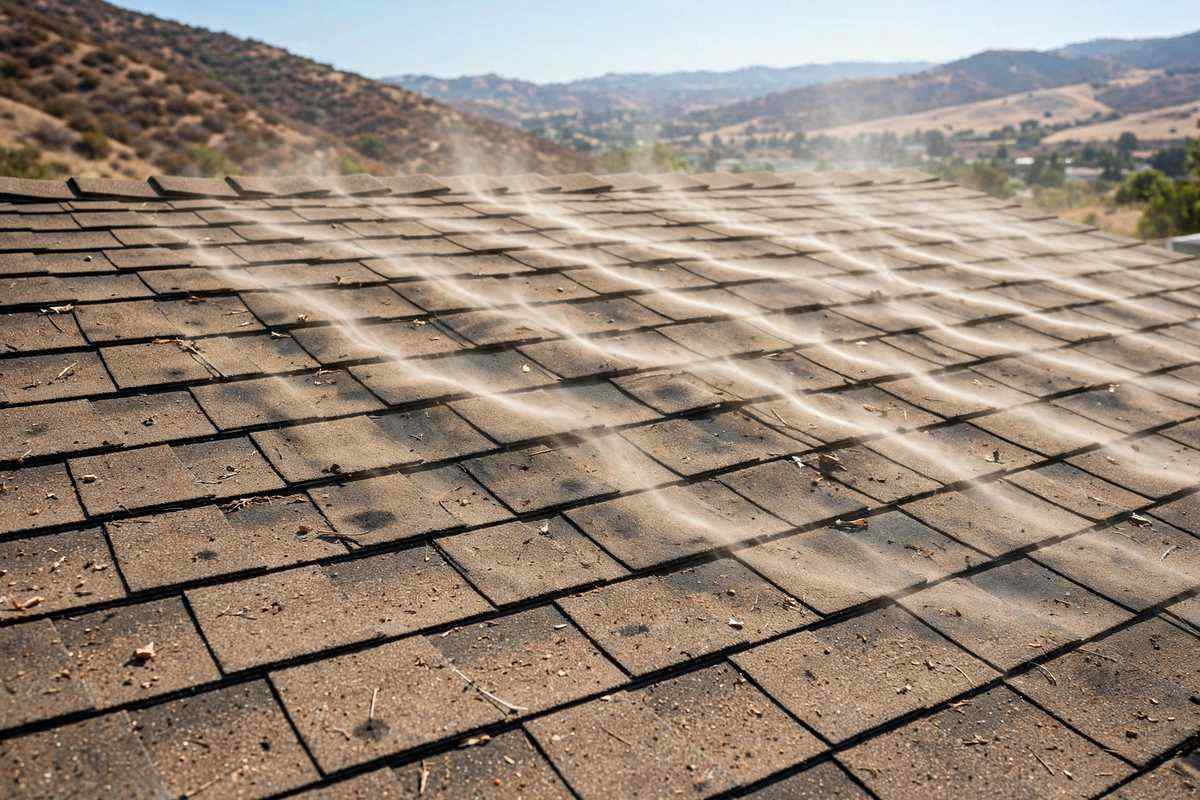
Summer heat in Simi Valley punishes a roof through ultraviolet exposure and thermal cycling, and preparation means ventilation, underlayment and covering chosen together, not a single product.
- Asphalt shingles lose volatiles. The oils that keep shingles flexible evaporate faster in sustained heat. A 25-year shingle in Simi Valley often shows real granule loss by year 12-15.
- Underlayment dries and cracks. Once the felt or synthetic underlayment fails, the next rain finds its way in - usually through a nail line or a valley.
- Wood and sealants shrink. Flashing seals, pipe boots, and skylight gaskets pull away from the deck as they cycle through 40-degree temperature swings between night and afternoon.
- Attic heat cooks the deck from below. A poorly vented attic bakes the underside of the roof sheathing, which warps it and loosens fasteners.
Before summer, check ridge and soffit ventilation as a system, clear valleys and gutters of debris that traps heat and moisture, and replace dried pipe boots and cracked sealants that the heat has already opened.
Start with a summer roof inspection in Simi Valley CA
On a full re-roof, the Climate Zone 9 cool-roof values apply: steep slopes at least 0.20 aged reflectance with 0.75 emittance or SRI 16, low slopes at least 0.63 with 0.75 emittance or SRI 75, with documented exceptions and trade-offs where they apply.
Simi Valley is an incorporated city in Ventura County, incorporated on 10 October 1969, and permits inside city limits run through the City of Simi Valley Building & Safety Division, not through LADBS. The City's own FAQ states that re-roofing of more than 10 percent of the total square footage of the roof, or over 100 square feet, requires a permit. A job can therefore need a City permit without triggering other code thresholds, and the permit route, the fee line and the inspection outcome are confirmed at application, not assumed from another city's rules.
- Deck and framing check. We look for sagging between rafters, soft spots, and popped nails - all signs the sheathing has been heat-cycled too many times.
- Shingle condition. Granule loss, curling edges, and hairline cracks along the tab lines. Curling is the classic heat-damage signature in this valley.
- Flashing and penetrations. Every pipe boot, chimney, and valley gets checked by hand. Most leaks we find start here, not in the field of shingles.
- Attic ventilation math. We measure net free vent area against the square footage of the attic. The 1:150 rule (1 sq ft of vent per 150 sq ft of attic floor) is the baseline; hot valleys often need more.
- Gutters and drainage. Even in a dry summer, a clogged gutter backs water up under the first course of shingles during the first fall rain.
For a single-family re-roof in CEC Climate Zone 9, the Title 24 Part 6 prescriptive cool-roof values are an aged solar reflectance of at least 0.20 with thermal emittance of at least 0.75, or an SRI of at least 16, on steep slopes of 2:12 or more, and at least 0.63 with emittance of at least 0.75, or an SRI of at least 75, on low slopes under 2:12. That requirement is triggered when more than 50 percent of the roof area is replaced, which is a different threshold from the City permit trigger, and the parcel's zone should be checked with the CEC zone finder before a product is specified.
Clear the roof surface and the drainage path
Simi Valley contains High and Very High Fire Hazard Severity Zone parcels, but it is not correct to say that all of Simi Valley is Very High. The parcel's zone must be checked in the CAL FIRE / VCFD Fire Hazard Severity Zone viewer, and on a wildland-urban interface parcel the current citation is Title 24 Part 7, the California Wildland-Urban Interface Code, not the retired CBC Chapter 7A. On such a parcel a Class A fire-rated roof assembly is required.
- Remove leaf litter and palm fronds. Wind-blown debris from the Santa Susana foothills piles up in valleys and behind chimneys. That debris holds moisture against the shingles and blocks airflow.
- Sweep the roof surface. A soft-bristle broom, not a pressure washer. Pressure washing drives water under shingle tabs and strips granules.
- Trim tree branches back. Anything within 6 feet of the roof drops debris and shades the surface unevenly, which accelerates wear on the sunny side.
Summer heat in Simi Valley punishes a roof through ultraviolet exposure and thermal cycling, and preparation means ventilation, underlayment and covering chosen together, not a single product.
Fix attic and roof ventilation before the first heat wave
Before summer, check ridge and soffit ventilation as a system, clear valleys and gutters of debris that traps heat and moisture, and replace dried pipe boots and cracked sealants that the heat has already opened.
On a full re-roof, the Climate Zone 9 cool-roof values apply: steep slopes at least 0.20 aged reflectance with 0.75 emittance or SRI 16, low slopes at least 0.63 with 0.75 emittance or SRI 75, with documented exceptions and trade-offs where they apply.
- Balanced intake and exhaust. Soffit vents pull cool air in; ridge or roof vents push hot air out. One without the other does almost nothing.
- Roughly 1 sq ft of net free vent area per 150 sq ft of attic floor as a starting point. Homes with dark shingles or west-facing roofs often need more.
- No blocked soffits. Insulation blown against the soffit vents is the number-one reason attic venting fails in older Simi Valley homes.
Simi Valley is an incorporated city in Ventura County, incorporated on 10 October 1969, and permits inside city limits run through the City of Simi Valley Building & Safety Division, not through LADBS. The City's own FAQ states that re-roofing of more than 10 percent of the total square footage of the roof, or over 100 square feet, requires a permit. A job can therefore need a City permit without triggering other code thresholds, and the permit route, the fee line and the inspection outcome are confirmed at application, not assumed from another city's rules.
Cool roof coatings and reflective surfaces
For a single-family re-roof in CEC Climate Zone 9, the Title 24 Part 6 prescriptive cool-roof values are an aged solar reflectance of at least 0.20 with thermal emittance of at least 0.75, or an SRI of at least 16, on steep slopes of 2:12 or more, and at least 0.63 with emittance of at least 0.75, or an SRI of at least 75, on low slopes under 2:12. That requirement is triggered when more than 50 percent of the roof area is replaced, which is a different threshold from the City permit trigger, and the parcel's zone should be checked with the CEC zone finder before a product is specified.
Simi Valley contains High and Very High Fire Hazard Severity Zone parcels, but it is not correct to say that all of Simi Valley is Very High. The parcel's zone must be checked in the CAL FIRE / VCFD Fire Hazard Severity Zone viewer, and on a wildland-urban interface parcel the current citation is Title 24 Part 7, the California Wildland-Urban Interface Code, not the retired CBC Chapter 7A. On such a parcel a Class A fire-rated roof assembly is required.
- Flat and low-slope roofs over garages, additions, and patio covers. These are the best candidates - the coating goes on in one or two passes and lasts 7-12 years with a recoat.
- Older modified bitumen or built-up roofs that are still watertight but running hot. A reflective coating buys you time before replacement.
- Metal roofs that have lost their factory finish and are absorbing rather than reflecting heat.
Summer heat in Simi Valley punishes a roof through ultraviolet exposure and thermal cycling, and preparation means ventilation, underlayment and covering chosen together, not a single product.
Check the details: flashing, skylights, and penetrations
Before summer, check ridge and soffit ventilation as a system, clear valleys and gutters of debris that traps heat and moisture, and replace dried pipe boots and cracked sealants that the heat has already opened.
On a full re-roof, the Climate Zone 9 cool-roof values apply: steep slopes at least 0.20 aged reflectance with 0.75 emittance or SRI 16, low slopes at least 0.63 with 0.75 emittance or SRI 75, with documented exceptions and trade-offs where they apply.
- Pipe boots. The rubber collar around plumbing vents cracks and pulls away. A $15 boot that fails causes a $1,500 ceiling repair.
- Chimney flashing. Look for lifted counter-flashing, cracked sealant at the base, and rust on the metal. Chimney flashing repair Simi Valley CA is a half-day job when it's caught early.
- Skylights. Check the gasket and the curb flashing. A leaking skylight usually shows up as a stain on the ceiling 3-4 feet downhill from the unit.
- Valley flashing. The metal in roof valleys takes the most thermal expansion. If the edges are lifting, water will find the seam.
Simi Valley is an incorporated city in Ventura County, incorporated on 10 October 1969, and permits inside city limits run through the City of Simi Valley Building & Safety Division, not through LADBS. The City's own FAQ states that re-roofing of more than 10 percent of the total square footage of the roof, or over 100 square feet, requires a permit. A job can therefore need a City permit without triggering other code thresholds, and the permit route, the fee line and the inspection outcome are confirmed at application, not assumed from another city's rules.
Common mistakes we see on Simi Valley roofs
For a single-family re-roof in CEC Climate Zone 9, the Title 24 Part 6 prescriptive cool-roof values are an aged solar reflectance of at least 0.20 with thermal emittance of at least 0.75, or an SRI of at least 16, on steep slopes of 2:12 or more, and at least 0.63 with emittance of at least 0.75, or an SRI of at least 75, on low slopes under 2:12. That requirement is triggered when more than 50 percent of the roof area is replaced, which is a different threshold from the City permit trigger, and the parcel's zone should be checked with the CEC zone finder before a product is specified.
- Sealing over wet or dirty surfaces. Roof cement and caulk won't bond to a dusty or damp surface. The patch fails within a season.
- Adding exhaust vents without intake. A ridge vent with blocked soffits just creates a dead zone. Ventilation is a system, not a single product.
- Ignoring the attic because the roof "looks fine." Heat damage starts on the underside of the deck long before it shows on the top.
- Waiting until the first 100°F day to call. By then, roofers are booked out 2-3 weeks, and you're paying emergency rates for what should have been routine maintenance.
When to call a professional
Simi Valley contains High and Very High Fire Hazard Severity Zone parcels, but it is not correct to say that all of Simi Valley is Very High. The parcel's zone must be checked in the CAL FIRE / VCFD Fire Hazard Severity Zone viewer, and on a wildland-urban interface parcel the current citation is Title 24 Part 7, the California Wildland-Urban Interface Code, not the retired CBC Chapter 7A. On such a parcel a Class A fire-rated roof assembly is required.
Summer heat in Simi Valley punishes a roof through ultraviolet exposure and thermal cycling, and preparation means ventilation, underlayment and covering chosen together, not a single product.
Frequently Asked Questions
How do I prepare my roof for summer heat in Simi Valley CA?
Before summer, check ridge and soffit ventilation as a system, clear valleys and gutters of debris that traps heat and moisture, and replace dried pipe boots and cracked sealants that the heat has already opened.
Can summer heat damage my roof in Simi Valley California?
On a full re-roof, the Climate Zone 9 cool-roof values apply: steep slopes at least 0.20 aged reflectance with 0.75 emittance or SRI 16, low slopes at least 0.63 with 0.75 emittance or SRI 75, with documented exceptions and trade-offs where they apply.
What roof maintenance should I do before summer in Simi Valley?
Simi Valley is an incorporated city in Ventura County, incorporated on 10 October 1969, and permits inside city limits run through the City of Simi Valley Building & Safety Division, not through LADBS. The City's own FAQ states that re-roofing of more than 10 percent of the total square footage of the roof, or over 100 square feet, requires a permit. A job can therefore need a City permit without triggering other code thresholds, and the permit route, the fee line and the inspection outcome are confirmed at application, not assumed from another city's rules.
How often should I inspect my roof in summer in Simi Valley CA?
For a single-family re-roof in CEC Climate Zone 9, the Title 24 Part 6 prescriptive cool-roof values are an aged solar reflectance of at least 0.20 with thermal emittance of at least 0.75, or an SRI of at least 16, on steep slopes of 2:12 or more, and at least 0.63 with emittance of at least 0.75, or an SRI of at least 75, on low slopes under 2:12. That requirement is triggered when more than 50 percent of the roof area is replaced, which is a different threshold from the City permit trigger, and the parcel's zone should be checked with the CEC zone finder before a product is specified.
Does a cool roof coating actually help in Simi Valley?
Simi Valley contains High and Very High Fire Hazard Severity Zone parcels, but it is not correct to say that all of Simi Valley is Very High. The parcel's zone must be checked in the CAL FIRE / VCFD Fire Hazard Severity Zone viewer, and on a wildland-urban interface parcel the current citation is Title 24 Part 7, the California Wildland-Urban Interface Code, not the retired CBC Chapter 7A. On such a parcel a Class A fire-rated roof assembly is required.
Get help with Roofing in Simi Valley
Summer heat in Simi Valley punishes a roof through ultraviolet exposure and thermal cycling, and preparation means ventilation, underlayment and covering chosen together, not a single product.