
A commercial flat roof in Simi Valley is maintained by drainage first: drains and scuppers clear, ponding checked after rain, and parapet flashing and seams inspected before the winter season.
How to maintain a flat roof on a commercial building in Simi Valley
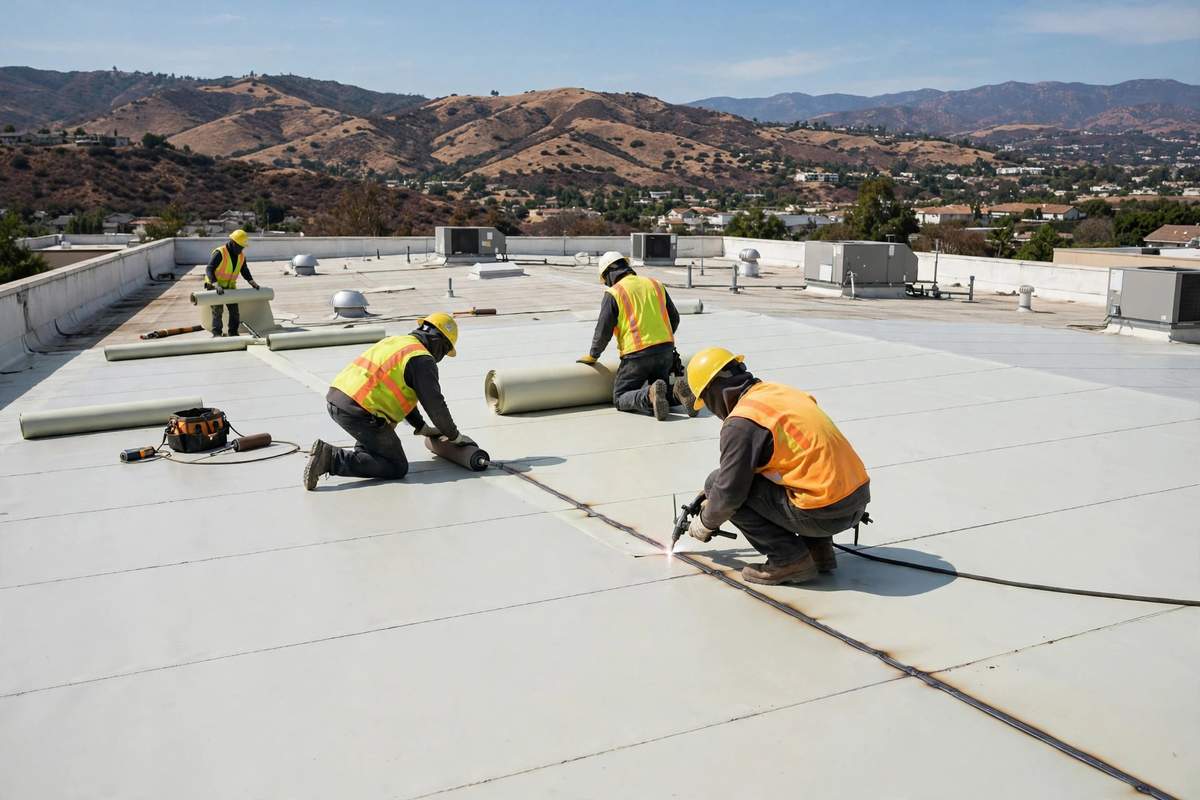
TPO and modified bitumen membranes fail at seams, curbs and drains before they fail in the field, so a maintenance visit photographs those details and records ponding areas, rather than walking the whole field and calling it done.
Simi Valley is an incorporated city in Ventura County, incorporated on 10 October 1969, and permits inside city limits run through the City of Simi Valley Building & Safety Division, not through LADBS. The City's own FAQ states that re-roofing of more than 10 percent of the total square footage of the roof, or over 100 square feet, requires a permit. A job can therefore need a City permit without triggering other code thresholds, and the permit route, the fee line and the inspection outcome are confirmed at application, not assumed from another city's rules.
For a single-family re-roof in CEC Climate Zone 9, the Title 24 Part 6 prescriptive cool-roof values are an aged solar reflectance of at least 0.20 with thermal emittance of at least 0.75, or an SRI of at least 16, on steep slopes of 2:12 or more, and at least 0.63 with emittance of at least 0.75, or an SRI of at least 75, on low slopes under 2:12. That requirement is triggered when more than 50 percent of the roof area is replaced, which is a different threshold from the City permit trigger, and the parcel's zone should be checked with the CEC zone finder before a product is specified.
Why flat roofs fail faster in Simi Valley
Simi Valley contains High and Very High Fire Hazard Severity Zone parcels, but it is not correct to say that all of Simi Valley is Very High. The parcel's zone must be checked in the CAL FIRE / VCFD Fire Hazard Severity Zone viewer, and on a wildland-urban interface parcel the current citation is Title 24 Part 7, the California Wildland-Urban Interface Code, not the retired CBC Chapter 7A. On such a parcel a Class A fire-rated roof assembly is required.
A commercial flat roof in Simi Valley is maintained by drainage first: drains and scuppers clear, ponding checked after rain, and parapet flashing and seams inspected before the winter season.
TPO and modified bitumen membranes fail at seams, curbs and drains before they fail in the field, so a maintenance visit photographs those details and records ponding areas, rather than walking the whole field and calling it done.
- Ponding water - low spots hold water for 48+ hours after rain, and the membrane under that water ages three times faster than the rest of the roof.
- UV degradation - the top layer of the membrane chalks, cracks, and loses its reflective granules.
- Thermal shock at seams and flashings - the joints move, the sealant dries out, and water finds the gap.
A coating is maintenance or renewal within a flat-roof scope on this site, not a standalone service and not a cure for a failed membrane, saturated insulation or a failed deck. Those are replacement scopes, and they are scoped as such.
How often should you inspect a commercial flat roof in Simi Valley?
Simi Valley is an incorporated city in Ventura County, incorporated on 10 October 1969, and permits inside city limits run through the City of Simi Valley Building & Safety Division, not through LADBS. The City's own FAQ states that re-roofing of more than 10 percent of the total square footage of the roof, or over 100 square feet, requires a permit. A job can therefore need a City permit without triggering other code thresholds, and the permit route, the fee line and the inspection outcome are confirmed at application, not assumed from another city's rules.
For a single-family re-roof in CEC Climate Zone 9, the Title 24 Part 6 prescriptive cool-roof values are an aged solar reflectance of at least 0.20 with thermal emittance of at least 0.75, or an SRI of at least 16, on steep slopes of 2:12 or more, and at least 0.63 with emittance of at least 0.75, or an SRI of at least 75, on low slopes under 2:12. That requirement is triggered when more than 50 percent of the roof area is replaced, which is a different threshold from the City permit trigger, and the parcel's zone should be checked with the CEC zone finder before a product is specified.
- March or April: Post-rain inspection. Look for ponding, lifted seams, and any debris the winter storms pushed into drains.
- July or August: Mid-summer heat check. Look for blisters, cracking, and UV damage on the membrane surface.
- October or November: Pre-winter prep. Clear every drain and scupper, re-seal any flashing that's pulling away, and confirm the roof is ready for rain.
- After any Santa Ana wind event or hail: Walk the roof within 48 hours. Wind-driven debris punctures membranes more often than people expect.
Simi Valley contains High and Very High Fire Hazard Severity Zone parcels, but it is not correct to say that all of Simi Valley is Very High. The parcel's zone must be checked in the CAL FIRE / VCFD Fire Hazard Severity Zone viewer, and on a wildland-urban interface parcel the current citation is Title 24 Part 7, the California Wildland-Urban Interface Code, not the retired CBC Chapter 7A. On such a parcel a Class A fire-rated roof assembly is required.
Seasonal flat roof maintenance checklist for Simi Valley
A commercial flat roof in Simi Valley is maintained by drainage first: drains and scuppers clear, ponding checked after rain, and parapet flashing and seams inspected before the winter season.
Spring (March-May)
- Remove leaves, twigs, and palm fronds from all drains and scuppers.
- Check for ponding - any water still standing 48 hours after rain is a problem.
- Inspect seams, flashings, and penetrations for lifting or cracking.
- Look for blisters - soft, spongy spots that feel like a bubble underfoot.
Summer (June-August)
- Check the membrane surface for chalking, cracking, and exposed reinforcement.
- Inspect HVAC curbs and pipe boots - the sealant around them dries out fast in the heat.
Fall (September-November)
- Full pre-winter inspection. This is the most important one.
- Clear drains again - fall debris is the number-one cause of winter ponding.
- Re-seal all flashing, terminations, and edge metal.
- Trim any tree branches within 10 feet of the roof.
Winter (December-February)
- Walk the roof after every major storm.
- Check interior ceilings for new stains - they show up before you see anything on the roof.
- Keep a log of every leak, patch, and repair. Patterns matter.
What maintenance does a flat roof need in Simi Valley California?
TPO and modified bitumen membranes fail at seams, curbs and drains before they fail in the field, so a maintenance visit photographs those details and records ponding areas, rather than walking the whole field and calling it done.
A coating is maintenance or renewal within a flat-roof scope on this site, not a standalone service and not a cure for a failed membrane, saturated insulation or a failed deck. Those are replacement scopes, and they are scoped as such.
Simi Valley is an incorporated city in Ventura County, incorporated on 10 October 1969, and permits inside city limits run through the City of Simi Valley Building & Safety Division, not through LADBS. The City's own FAQ states that re-roofing of more than 10 percent of the total square footage of the roof, or over 100 square feet, requires a permit. A job can therefore need a City permit without triggering other code thresholds, and the permit route, the fee line and the inspection outcome are confirmed at application, not assumed from another city's rules.
For a single-family re-roof in CEC Climate Zone 9, the Title 24 Part 6 prescriptive cool-roof values are an aged solar reflectance of at least 0.20 with thermal emittance of at least 0.75, or an SRI of at least 16, on steep slopes of 2:12 or more, and at least 0.63 with emittance of at least 0.75, or an SRI of at least 75, on low slopes under 2:12. That requirement is triggered when more than 50 percent of the roof area is replaced, which is a different threshold from the City permit trigger, and the parcel's zone should be checked with the CEC zone finder before a product is specified.
Simi Valley contains High and Very High Fire Hazard Severity Zone parcels, but it is not correct to say that all of Simi Valley is Very High. The parcel's zone must be checked in the CAL FIRE / VCFD Fire Hazard Severity Zone viewer, and on a wildland-urban interface parcel the current citation is Title 24 Part 7, the California Wildland-Urban Interface Code, not the retired CBC Chapter 7A. On such a parcel a Class A fire-rated roof assembly is required.
Common mistakes that shorten flat roof life
A commercial flat roof in Simi Valley is maintained by drainage first: drains and scuppers clear, ponding checked after rain, and parapet flashing and seams inspected before the winter season.
- Letting debris sit in the drains. One season of leaves turns a working drain into a pond.
- Walking the roof in the wrong shoes. Cleats and hard soles puncture TPO and EPDM. Wear soft-soled shoes, and stay on the walkway pads.
- Patching with the wrong material. A tar patch on a TPO membrane will fail within a year. Match the patch to the membrane.
- Ignoring small blisters. A 6-inch blister becomes a 6-foot delamination after one more summer.
- Skipping the fall inspection. The pre-winter walk-through is the one that prevents emergency calls in January.
- Adding HVAC units without re-flashing the curb. Every new penetration is a new leak waiting to happen.
TPO and modified bitumen membranes fail at seams, curbs and drains before they fail in the field, so a maintenance visit photographs those details and records ponding areas, rather than walking the whole field and calling it done.
When to call a professional
A coating is maintenance or renewal within a flat-roof scope on this site, not a standalone service and not a cure for a failed membrane, saturated insulation or a failed deck. Those are replacement scopes, and they are scoped as such.
Simi Valley is an incorporated city in Ventura County, incorporated on 10 October 1969, and permits inside city limits run through the City of Simi Valley Building & Safety Division, not through LADBS. The City's own FAQ states that re-roofing of more than 10 percent of the total square footage of the roof, or over 100 square feet, requires a permit. A job can therefore need a City permit without triggering other code thresholds, and the permit route, the fee line and the inspection outcome are confirmed at application, not assumed from another city's rules.
Frequently Asked Questions
How do I maintain a flat roof on a commercial building in Simi Valley CA?
For a single-family re-roof in CEC Climate Zone 9, the Title 24 Part 6 prescriptive cool-roof values are an aged solar reflectance of at least 0.20 with thermal emittance of at least 0.75, or an SRI of at least 16, on steep slopes of 2:12 or more, and at least 0.63 with emittance of at least 0.75, or an SRI of at least 75, on low slopes under 2:12. That requirement is triggered when more than 50 percent of the roof area is replaced, which is a different threshold from the City permit trigger, and the parcel's zone should be checked with the CEC zone finder before a product is specified.
How often should a commercial flat roof be inspected in Simi Valley?
Simi Valley contains High and Very High Fire Hazard Severity Zone parcels, but it is not correct to say that all of Simi Valley is Very High. The parcel's zone must be checked in the CAL FIRE / VCFD Fire Hazard Severity Zone viewer, and on a wildland-urban interface parcel the current citation is Title 24 Part 7, the California Wildland-Urban Interface Code, not the retired CBC Chapter 7A. On such a parcel a Class A fire-rated roof assembly is required.
What maintenance does a flat roof need in Simi Valley California?
A commercial flat roof in Simi Valley is maintained by drainage first: drains and scuppers clear, ponding checked after rain, and parapet flashing and seams inspected before the winter season.
Can you repair a commercial flat roof in Simi Valley CA?
TPO and modified bitumen membranes fail at seams, curbs and drains before they fail in the field, so a maintenance visit photographs those details and records ponding areas, rather than walking the whole field and calling it done.
Get help with Roofing in Simi Valley
A coating is maintenance or renewal within a flat-roof scope on this site, not a standalone service and not a cure for a failed membrane, saturated insulation or a failed deck. Those are replacement scopes, and they are scoped as such.
Simi Valley is an incorporated city in Ventura County, incorporated on 10 October 1969, and permits inside city limits run through the City of Simi Valley Building & Safety Division, not through LADBS. The City's own FAQ states that re-roofing of more than 10 percent of the total square footage of the roof, or over 100 square feet, requires a permit. A job can therefore need a City permit without triggering other code thresholds, and the permit route, the fee line and the inspection outcome are confirmed at application, not assumed from another city's rules.