
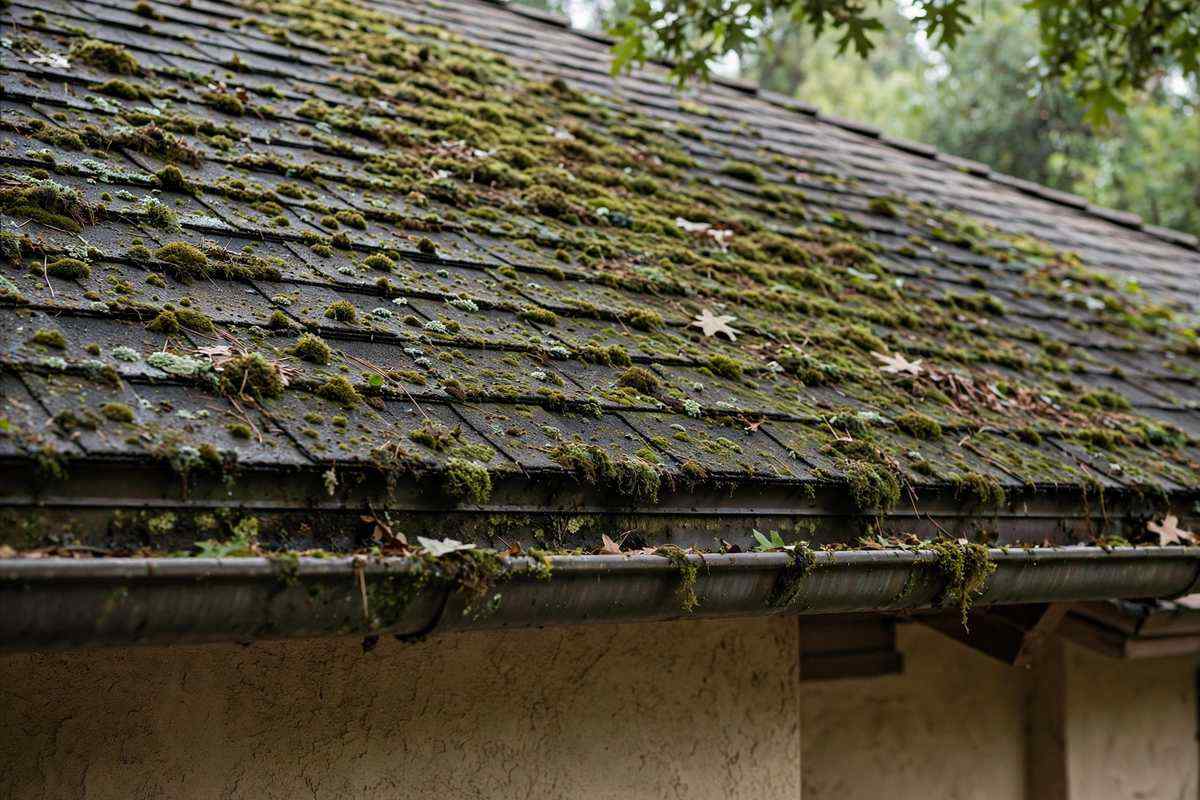
Moss grows on shaded north slopes in Simi Valley, where a slope stays damp after rain and debris collects. It holds moisture against the shingle, and it is a symptom to read, not just a stain to remove.
How to clean moss off your shingle roof safely
Safe moss cleaning means working from a ladder or the ground where possible, never pressure-washing shingles, and removing the debris that keeps the slope damp. A roof that is walked on wet, or blasted clean, loses granules it cannot regain.
Simi Valley is an ageing tract re-roof market, not a new-construction market. Most Simi Valley homes were built in the 1960s and the 1980s, with a median construction year in the late 1970s. A large share of roofs therefore sit on homes 35 to 65 years old, at or beyond a first or second re-roof cycle on age grounds alone, so each roof still needs its own inspection.
Roof demand in Simi Valley is driven by inland heat and ultraviolet exposure, concentrated winter rain, and Santa Ana wind, not by snow. Rain is strongly winter-concentrated and summers are essentially dry, so valleys, flashings and drains sit dry and collect debris for months and are then tested in a handful of winter storms. Santa Ana gusts in Simi Valley have been recorded at 62 mph, as on 4-5 October 2013.
Why moss grows on Simi Valley shingle roofs
A recent local fire was the Easy Fire, 30 October to 2 November 2019, at 1,806 acres, ignited near Easy Street and Madera Road at the westerly end of Simi Valley. The Woolsey Fire ignited on 8 November 2018 south of Simi Valley on or near the Santa Susana Field Laboratory and burned about 80 percent of that site.
Moss grows on shaded north slopes in Simi Valley, where a slope stays damp after rain and debris collects. It holds moisture against the shingle, and it is a symptom to read, not just a stain to remove.
Safe moss cleaning means working from a ladder or the ground where possible, never pressure-washing shingles, and removing the debris that keeps the slope damp. A roof that is walked on wet, or blasted clean, loses granules it cannot regain.
Is moss on my roof a problem in Simi Valley California?
If moss returns quickly, the cause is shade, drainage or a valley that stays wet, and that cause is fixed before another cleaning is sold. Moss on a tile roof is a different job, because tile can be lifted and cleaned without the same granule risk.
Simi Valley is an ageing tract re-roof market, not a new-construction market. Most Simi Valley homes were built in the 1960s and the 1980s, with a median construction year in the late 1970s. A large share of roofs therefore sit on homes 35 to 65 years old, at or beyond a first or second re-roof cycle on age grounds alone, so each roof still needs its own inspection.
- Lifted shingle tabs along the moss line, usually the first three to four courses up from the eave.
- Granule loss - the black grit you see in gutters after a rain is your shingles' UV protection washing away.
- Soft decking in the affected area, which we confirm by walking the roof and probing with a screwdriver.
- Clogged gutters from moss and shingle debris, which backs water up under the eave and rots the fascia.
Roof demand in Simi Valley is driven by inland heat and ultraviolet exposure, concentrated winter rain, and Santa Ana wind, not by snow. Rain is strongly winter-concentrated and summers are essentially dry, so valleys, flashings and drains sit dry and collect debris for months and are then tested in a handful of winter storms. Santa Ana gusts in Simi Valley have been recorded at 62 mph, as on 4-5 October 2013.
Tools and materials you actually need
A recent local fire was the Easy Fire, 30 October to 2 November 2019, at 1,806 acres, ignited near Easy Street and Madera Road at the westerly end of Simi Valley. The Woolsey Fire ignited on 8 November 2018 south of Simi Valley on or near the Santa Susana Field Laboratory and burned about 80 percent of that site.
Moss grows on shaded north slopes in Simi Valley, where a slope stays damp after rain and debris collects. It holds moisture against the shingle, and it is a symptom to read, not just a stain to remove.
- Moss killer - either a commercial zinc-sulfate or potassium-salt product, or a 50/50 mix of white vinegar and water for light growth. Never mix bleach with anything but water.
- Soft-bristle brush on a long pole, so you can work from a ladder or from the roof without leaning out over the edge.
- Plastic scraper - never a metal one. Metal gouges the shingle surface.
- Pump sprayer - 1 to 2 gallons is enough for a 1,500 sq ft roof.
- Safety gear - non-slip shoes, roof harness if your pitch is steeper than 6/12, and eye protection.
Safe moss cleaning means working from a ladder or the ground where possible, never pressure-washing shingles, and removing the debris that keeps the slope damp. A roof that is walked on wet, or blasted clean, loses granules it cannot regain.
How to clean moss off your shingle roof safely in Simi Valley CA
If moss returns quickly, the cause is shade, drainage or a valley that stays wet, and that cause is fixed before another cleaning is sold. Moss on a tile roof is a different job, because tile can be lifted and cleaned without the same granule risk.
Step 1: Kill the moss
Simi Valley is an ageing tract re-roof market, not a new-construction market. Most Simi Valley homes were built in the 1960s and the 1980s, with a median construction year in the late 1970s. A large share of roofs therefore sit on homes 35 to 65 years old, at or beyond a first or second re-roof cycle on age grounds alone, so each roof still needs its own inspection.
Step 2: Remove the dead moss
Roof demand in Simi Valley is driven by inland heat and ultraviolet exposure, concentrated winter rain, and Santa Ana wind, not by snow. Rain is strongly winter-concentrated and summers are essentially dry, so valleys, flashings and drains sit dry and collect debris for months and are then tested in a handful of winter storms. Santa Ana gusts in Simi Valley have been recorded at 62 mph, as on 4-5 October 2013.
Step 3: Clear the valleys and gutters
A recent local fire was the Easy Fire, 30 October to 2 November 2019, at 1,806 acres, ignited near Easy Street and Madera Road at the westerly end of Simi Valley. The Woolsey Fire ignited on 8 November 2018 south of Simi Valley on or near the Santa Susana Field Laboratory and burned about 80 percent of that site.
Step 4: Rinse gently
Moss grows on shaded north slopes in Simi Valley, where a slope stays damp after rain and debris collects. It holds moisture against the shingle, and it is a symptom to read, not just a stain to remove.
Safe moss cleaning means working from a ladder or the ground where possible, never pressure-washing shingles, and removing the debris that keeps the slope damp. A roof that is walked on wet, or blasted clean, loses granules it cannot regain.
What to watch out for
If moss returns quickly, the cause is shade, drainage or a valley that stays wet, and that cause is fixed before another cleaning is sold. Moss on a tile roof is a different job, because tile can be lifted and cleaned without the same granule risk.
- Walking the roof in wet shoes. Asphalt shingles are slick when damp. Wait for a dry afternoon.
- Using bleach at full strength. It kills moss but also oxidizes the shingle mat and kills landscaping below.
- Scraping with a metal tool. You will gouge the shingle surface and create a new place for water to sit.
- Ignoring the flashing. If moss has grown around a vent or chimney, the sealant underneath is probably compromised.
- Cleaning in the wrong season. Applying moss killer right before a rain just washes it off.
Simi Valley is an ageing tract re-roof market, not a new-construction market. Most Simi Valley homes were built in the 1960s and the 1980s, with a median construction year in the late 1970s. A large share of roofs therefore sit on homes 35 to 65 years old, at or beyond a first or second re-roof cycle on age grounds alone, so each roof still needs its own inspection.
Preventing moss from coming back
Roof demand in Simi Valley is driven by inland heat and ultraviolet exposure, concentrated winter rain, and Santa Ana wind, not by snow. Rain is strongly winter-concentrated and summers are essentially dry, so valleys, flashings and drains sit dry and collect debris for months and are then tested in a handful of winter storms. Santa Ana gusts in Simi Valley have been recorded at 62 mph, as on 4-5 October 2013.
A recent local fire was the Easy Fire, 30 October to 2 November 2019, at 1,806 acres, ignited near Easy Street and Madera Road at the westerly end of Simi Valley. The Woolsey Fire ignited on 8 November 2018 south of Simi Valley on or near the Santa Susana Field Laboratory and burned about 80 percent of that site.
Moss grows on shaded north slopes in Simi Valley, where a slope stays damp after rain and debris collects. It holds moisture against the shingle, and it is a symptom to read, not just a stain to remove.
When to call a professional
Safe moss cleaning means working from a ladder or the ground where possible, never pressure-washing shingles, and removing the debris that keeps the slope damp. A roof that is walked on wet, or blasted clean, loses granules it cannot regain.
If moss returns quickly, the cause is shade, drainage or a valley that stays wet, and that cause is fixed before another cleaning is sold. Moss on a tile roof is a different job, because tile can be lifted and cleaned without the same granule risk.
Frequently Asked Questions
How do I clean moss off my shingle roof in Simi Valley CA?
Simi Valley is an ageing tract re-roof market, not a new-construction market. Most Simi Valley homes were built in the 1960s and the 1980s, with a median construction year in the late 1970s. A large share of roofs therefore sit on homes 35 to 65 years old, at or beyond a first or second re-roof cycle on age grounds alone, so each roof still needs its own inspection.
Is moss on my roof a problem in Simi Valley California?
Roof demand in Simi Valley is driven by inland heat and ultraviolet exposure, concentrated winter rain, and Santa Ana wind, not by snow. Rain is strongly winter-concentrated and summers are essentially dry, so valleys, flashings and drains sit dry and collect debris for months and are then tested in a handful of winter storms. Santa Ana gusts in Simi Valley have been recorded at 62 mph, as on 4-5 October 2013.
What is the safest way to remove roof moss in Simi Valley?
A recent local fire was the Easy Fire, 30 October to 2 November 2019, at 1,806 acres, ignited near Easy Street and Madera Road at the westerly end of Simi Valley. The Woolsey Fire ignited on 8 November 2018 south of Simi Valley on or near the Santa Susana Field Laboratory and burned about 80 percent of that site.
Can moss damage my shingle roof in Simi Valley CA?
Moss grows on shaded north slopes in Simi Valley, where a slope stays damp after rain and debris collects. It holds moisture against the shingle, and it is a symptom to read, not just a stain to remove.
How much does moss removal cost in Simi Valley?
Safe moss cleaning means working from a ladder or the ground where possible, never pressure-washing shingles, and removing the debris that keeps the slope damp. A roof that is walked on wet, or blasted clean, loses granules it cannot regain.
Get help with Roofing in Simi Valley
If moss returns quickly, the cause is shade, drainage or a valley that stays wet, and that cause is fixed before another cleaning is sold. Moss on a tile roof is a different job, because tile can be lifted and cleaned without the same granule risk.
Simi Valley is an ageing tract re-roof market, not a new-construction market. Most Simi Valley homes were built in the 1960s and the 1980s, with a median construction year in the late 1970s. A large share of roofs therefore sit on homes 35 to 65 years old, at or beyond a first or second re-roof cycle on age grounds alone, so each roof still needs its own inspection.